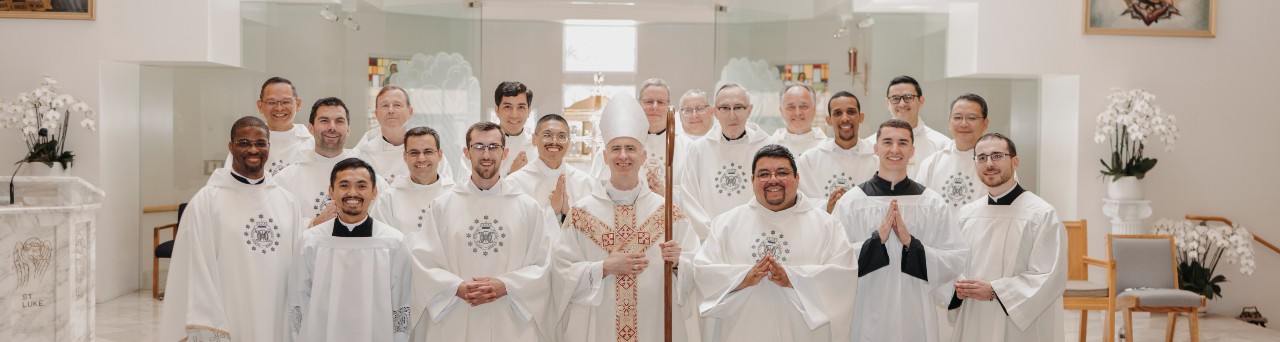
If you’ve ever wondered how to become a Catholic priest, not just the end result, but the years-long journey of formation and discernment—this article is for you. Whether you’re exploring a vocation yourself or simply curious about religious life, here’s an honest look at the road from first question to final ordination.
It Starts With a Question, Not an Answer
Most men who enter religious life don’t begin with certainty. They begin with a nagging sense that God might be asking something greater of them—that might be a pull toward prayer, a restlessness that ordinary things don’t satisfy, a desire to give their life to something bigger than themselves.
That question deserves to be taken seriously. The first step isn’t signing up for anything. It’s starting a conversation. If you’re wondering whether God might be calling you, we’d love to hear from you.
The OMV Path to Becoming a Catholic Priest
An Eight-Year Formation Journey
Becoming a Catholic priest is intentionally unhurried. The Church isn’t looking for men who are merely enthusiastic, she’s looking for men who are formed: spiritually, intellectually, humanly. Here’s what that looks like. We also invite you to explore the full formation process.
Years 1–2: Postulancy
The journey begins with postulancy, a two-year period designed to help a man discern whether this life is truly his. During this time, he studies philosophy and liberal arts, begins to understand the meaning of religious vows, and lives alongside the community. It’s an invitation to ask hard questions in a supportive environment, not a test to pass, but a relationship to begin.
Years 3: Novitiate
The novitiate is a year of intensive spiritual formation. A novice steps back from academic work to go deep into prayer, the study of religious life, and the particular charism. This is the year a man prepares for his first profession of temporary vows. It is demanding, clarifying, and for many, transformative.
Years 4–8: Theologate
Over five years, a seminarian studies theology and prepares for both his final (perpetual) profession and ordination to the priesthood. This isn’t purely academic; summers and a pastoral year place him in active ministry alongside other Oblates, learning what it means to live and serve as a priest in the world.
Meet the Men in Formation with the Oblates
What You’re Saying Yes To: The Three Vows
At several points along the way, first in temporary vows, and ultimately in perpetual profession, a priest commits himself to poverty, chastity, and obedience. These aren’t restrictions. They are a way of life that frees a man to love God and serve others without reservation.
- Poverty: A life of simplicity, holding material things in common with his brothers rather than for himself.
- Chastity: A gift of the whole heart to God, an undivided love that becomes available to everyone.
- Obedience: Entrusting his will to God through the community, trusting that discernment done together is discernment done well.
Ordination: The Summit and the Beginning
After years of formation, a man is ordained a priest—configured to Christ in a new and permanent way, given the grace to preach, celebrate the sacraments, and shepherd God’s people. For the Oblates, ordination isn’t a graduation. It’s an entry into a lifetime of mission, prayer, and brotherhood.
Is This Path for You?
The priesthood seeks men who are serious about God, willing to open their hearts, and willing to be formed. If that sounds like you—or even if you’re not sure—the best thing you can do is take one step: reach out and start a conversation.
You can also attend a Come & See retreat, it’s a low-commitment opportunity to spend time with the OMV community, ask questions, and pray. No pressure or obligation. Just an open door.
